



Gyula Deák Bill, one of the most influential singers in Hungarian blues, has died at the age of seventy-seven.
As a performer with the HOBO BLUES BAND, ‘Kopaszkutya’, and through his defining solo albums, he did not simply copy American models; instead, he gave an unmistakable voice to the streets of Kőbánya, to suburban life, to loss, and to the resilience required to keep standing.
Gyula Deák Bill’s death was announced on September 17 on his official social media page. According to the statement, he passed away unexpectedly following a surgery that had been considered successful.
“The microphone has fallen silent,” the post read. This phrase is particularly apt, as for Bill, his voice was not merely a tool for performance; it was his very personality—dark, gritty, yet flexible; simultaneously heavy and vulnerable.
According to a remark attributed to Chuck Berry – one that has since become legendary – he was “the white singer with the blackest voice.” While this description aptly captured the power of his vocals, it did not tell the whole story.
For Deák Bill did not take the stage wearing some borrowed American blues mask. What he sang was rooted in a specific Budapest locale: Kőbánya.
Born in Budapest in 1948, he remained deeply attached throughout his life to the suburban environment where he began his journey. In his songs, Kőbánya was not a working-class district softened into a romanticized setting; it was a world of railway tracks, factories, pubs, cramped apartments, tough masculine roles, and communities bound by mutual reliance—a place where a person’s worth was defined less by their background or education than by their character and authenticity.
“Kőbánya Blues” thus became far more than just a song or a geographical reference; it came to signify a uniquely Hungarian expression of the blues. Through Bill’s voice, the genre’s fundamental tenet — that pain should not be erased but given form—found a natural resonance with the atmosphere of Budapest’s outer districts.
His career began in small local bands, including Sztár; later, he sang for Napsugár, Wanderers, and Loyd. He explored jazz, soul, and rhythm and blues, but truly found his own distinctive voice in the late 1970s when he joined the HOBO BLUES BAND.
In the HOBO BLUES BAND, László Földes’s lyrical world and stage persona were complemented by Deák Bill’s more instinctive, elemental vocal style. The contrast between the two generated the tension that defined the band’s classic era. Hobo was the storyteller shifting between roles, while Bill was the voice whose very first note lent authenticity to the tale.
Albums such as ‘Közép-európai Hobo Blues’, ‘Oly sokáig voltunk lenn’, ‘Még élünk’, and the ambitious ‘Vadászat’ became essential milestones in the history of Hungarian rock.
On these recordings, the blues did not appear as an exotic import, but rather as a language articulating the confinement, compromises, and yearning for freedom characteristic of the late Kádár era.
Bill did not sing using technical gimmicks. His voice carried the uplift of gospel, the visceral power of soul, and the brokenness of the blues—but above all, it possessed that rare quality where the listener perceived a personal confession, even when the performer was delivering lyrics written by someone else.
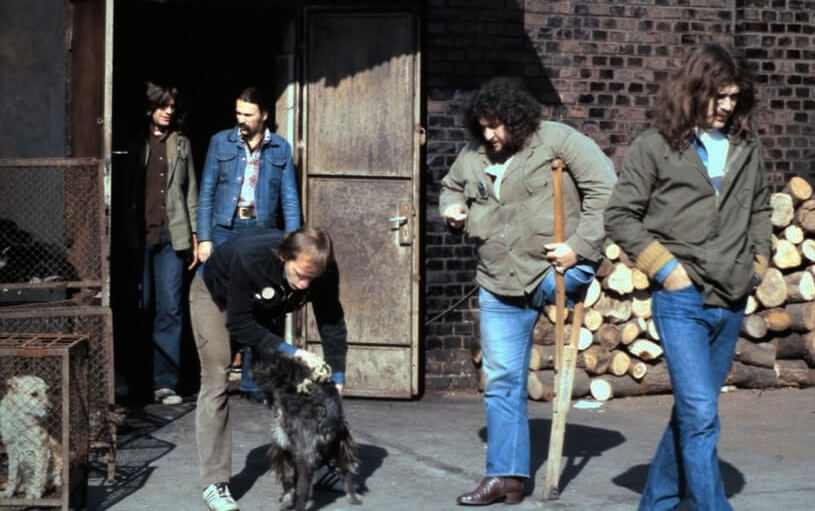
György Szomjas’s 1981 film ‘Kopaszkutya’ (Bald Dog) not only captured the fringes of the Hungarian rock scene of that era but also elevated them to the status of myth. In the film, Deák Bill essentially played himself: a musician whose talent and presence were too immense for the system to comfortably pigeonhole him, yet whose very outsider status made him authentic.
Behind the film’s raw clubs, smoky dressing rooms, vulnerable musicians, and volatile audiences, the experience of an entire generation took shape. Bill was not merely a decorative figure in the film, but proof that this music truly existed. He did not create a character through acting techniques; it was enough for him to simply step into the frame and sing.
Due to political and record-label obstacles, the film’s soundtrack could only be released as a standalone album much later, in 1993.
After leaving the HOBO BLUES BAND, he embarked on a solo career. ‘Rossz vér’ (Bad Blood) and ‘Mindhalálig blues’ (Blues Until the End) were not simply successful albums; they demonstrated that his voice could create a compelling narrative of its own, independent of the HBB universe.
His later albums—including ‘Bűnön, bűnhődés’ (Crime and Punishment), ‘Bort, bluest, békességet’ (Wine, Blues, and Peace), ‘Hatvan csapás’ (Sixty Blows), and ‘A király meséi’ (Tales of the King) — further built upon this body of work. He did not desperately chase contemporary sounds, nor did he try to appear younger than he was. He traversed the same world again and again: desire, betrayal, love, poverty, guilt, punishment, and survival.
The 1983 premiere of ‘István, a király’ (Stephen, the King) marked a decisive turning point in his stage career. His performance as Torda the Shaman was so electrifying that it made him a household name far beyond the blues and rock communities.
Forty-three years later, on August 9, 2026, he once again took the stage at the Sziget Main Stage with these songs, performing at the event dedicated to the body of work of János Bródy. He was brought out in a wheelchair, and during the pauses between songs, he even tried to wave away the medical staff hovering nearby. Yet, the moment he began to sing, his physical condition faded into the background: ‘Áldozatunk fogadjátok’ and ‘Véres kardot hoztam’ filled the space with the same dramatic power they had decades earlier.
The performance became one of his final major public appearances and served as a vivid illustration of how he had navigated his physical limitations throughout his life: he never denied them, yet he refused to let them dominate the stage. Seated in a wheelchair but singing with elemental energy, Bill demonstrated that the power of a performer stems not from freedom of movement, but from the strength of one’s presence.
As a child, he wanted to be a footballer. However, at the age of eleven, he lost a leg following a medical procedure he regarded as an instance of malpractice. This loss closed the door on a football career and shaped his entire life, yet in his public appearances, he never asked to be viewed as a tragic hero or an object of pity.
He did not hide his disability, nor did he turn it into a performance gimmick. While the crutch was part of his stage presence, it never took the place of the performance itself. The audience’s attention was drawn to him not because he stood on stage with one leg, but because, the moment he began to sing, he filled the entire space.
This does not mean he bore his condition lightly. In interviews, he spoke about his lost dream of becoming a footballer, the physical pain, and the mobility issues that grew increasingly severe over the decades. Yet, he consistently prioritized his work, his family, and his audience. He did not deny his injury; rather, he refused to be defined solely by it.
His presence thus became one of the most powerful examples in Hungarian popular music showing that disability is not some sort of moral parable, but simply a part of a person’s life.
He did not “conquer” his impairment, nor did he pretend it did not exist. He lived with it and worked with it, building a major career without allowing his body to dictate the limits of his artistic possibilities.
Gyula Deák Bill has retained his audience across generations. He performed in large arenas and small clubs with the same directness. He never distanced himself from the world he came from, nor did he trade the simple, weighty truths of the blues for the more comfortable roles of stardom.
His passing marked the loss of not only an exceptional singing voice from the Hungarian music scene, but also the departure of one of the last great figures of an era when an artist could be backed by an entire neighborhood, a social milieu, and a shared experience.
Through his voice, Kőbánya was not the end of the world, but its center. From that vantage point, he sang of love, loss, the downtrodden, and those who try to rise again after every blow. This was the essence of Gyula Deák Bill’s entire career — and that is why he remains with us, even now that the microphone has fallen silent.